EPA 608 vs 609 Certification: Differences and Which One You Need
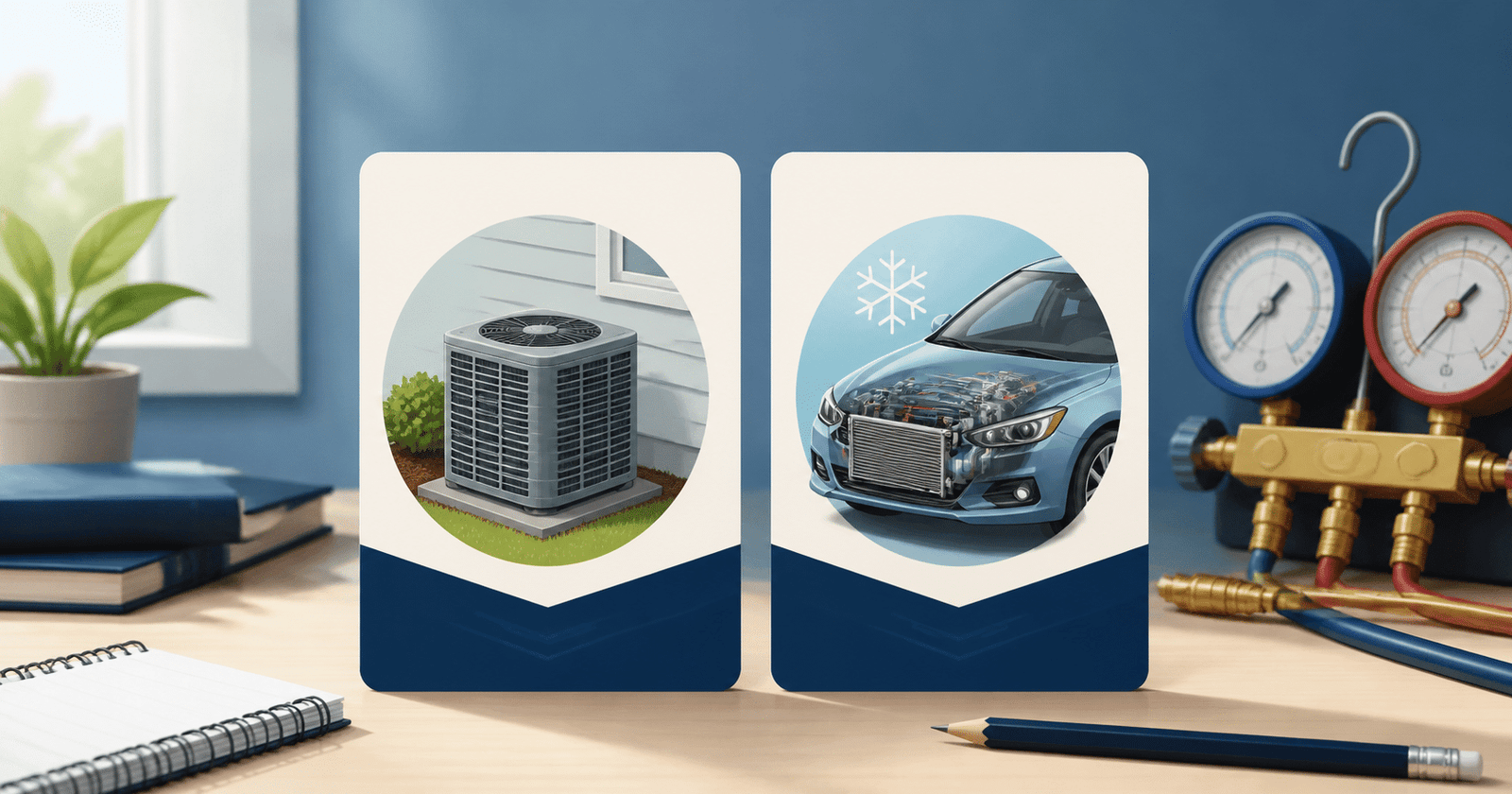
Quick answer: EPA Section 608 certification is for technicians who service stationary air-conditioning and refrigeration equipment. EPA Section 609 certification is for people who service motor vehicle air-conditioning systems for payment. The right credential depends on the equipment you work on—not on the brand of refrigerant.
In this guide
EPA 608 vs 609 at a glance
| Section 608 | Section 609 | |
|---|---|---|
| Equipment covered | Stationary air conditioning and refrigeration: homes, buildings, commercial refrigeration, chillers | Motor vehicle air conditioning (MVAC) in cars, trucks and buses that use CFC-12, when serviced for payment or barter |
| Certification types | Core plus Type I, II or III; Universal covers all three | One certification |
| Test format | 25 questions per section. Universal requires Core and all three types, closed book and proctored. Type I may be offered unproctored. | Open book, usually online. 25 questions (MACS, Mainstream), 30 (ASE) or 50 (ESCO) |
| Pass mark | 18 of 25 per section (72%) | 84% at MACS, Mainstream and ESCO; 24 of 30 at ASE |
| Typical cost | Varies by program and proctoring; see the EPA 608 cost guide | About $20 to $29 online (ESCO $20, ASE $23, MACS $29) |
| Expires? | No (details) | No |
| Refrigerant purchases | Required to buy ozone-depleting and non-exempt substitute refrigerants, such as R-22 and R-410A | Only refrigerant acceptable for use in MVACs, such as R-134a, R-1234yf and CFC-12; not HCFC-22 in any size |
| Car A/C work? | No | Yes |
| Off-road MVAC-like equipment | Type II qualifies | Qualifies (EPA recommends 609) |
| Federal rule | 40 CFR Part 82, Subpart F | 40 CFR Part 82, Subpart B |
Practice before you book: try the free EPA 608 practice test (Core, Type I, II and III) or the EPA 609 practice test.
Start with the equipment, not the course name
The two credentials are often grouped together because both deal with refrigerant handling under the Clean Air Act. They are not interchangeable. A shop that services passenger-car air conditioning has a different certification requirement from a technician who works on a home split system, supermarket case, rooftop unit, or walk-in cooler.
| If you service… | Usually the relevant certification | Why |
|---|---|---|
| Residential and commercial stationary HVAC&R equipment | Section 608 | It covers stationary refrigeration and air-conditioning equipment. |
| Motor vehicle air-conditioning (MVAC) systems for payment | Section 609 | It covers refrigerant recovery and service work on vehicle A/C systems. |
| Both stationary HVAC&R and vehicle A/C | Both, when your work includes both systems | Each program applies to a different equipment category. |
What Section 608 covers
Section 608 is the credential most HVAC technicians mean when they say “EPA certification.” It is organized around the type of stationary equipment being serviced:
- Type I: small appliances.
- Type II: medium-, high-, and very high-pressure appliances within its scope, excluding small appliances and MVACs. MVAC-like appliances have a separate Type II/609 option.
- Type III: low-pressure appliances.
- Universal: all three equipment categories.
Universal certification requires passing Core and all three Type sections through an EPA-approved program under closed-book, proctored conditions. Open-book Core and mail-in Type I scores cannot count toward Universal. For people headed into residential or commercial HVAC work, it is usually the most flexible long-term option because it does not limit the equipment categories they can service.
What Section 609 covers
Section 609 applies to technicians who repair or service motor vehicle air-conditioning systems for consideration—such as payment or bartering. The training focuses on appropriate recovery equipment, regulatory requirements, and safe refrigerant handling for MVAC systems. A Section 609 card does not turn into a Section 608 credential just because a vehicle uses a familiar refrigerant.
Accuracy review: October 22, 2026.
The MVAC-like exception
For qualifying MVAC-like appliances on off-road agricultural or construction equipment, technicians may hold either Section 608 Type II or Section 609. Certification is required for that service even when the technician is not paid. Do not classify every cooling system on a vehicle as MVAC: cargo refrigeration and passenger-compartment cooling are different applications. Check EPA’s overlap guidance and the certification rule for the equipment you service.
A simple decision guide
- Working on homes, buildings, refrigeration, or stationary equipment? Choose a Section 608 program that covers the equipment you intend to service.
- Servicing passenger-compartment MVAC systems for payment or barter? Look for an EPA-approved Section 609 training and certification program.
- Doing both? Plan on meeting both requirements. Ask your employer which systems you will actually service before paying for training.
Can a 608-certified technician work on car A/C?
No. EPA says motor vehicle air conditioners “are not subject to the servicing requirements under Section 608,” and servicing them requires certification from an EPA-approved Section 609 program. The only overlap is MVAC-like appliances such as farm and construction equipment, where Section 608 Type II or Section 609 both qualify. Buses that use HCFC-22 are the reverse case: EPA treats them as high-pressure equipment covered by Section 608 Type II, not as MVACs.
Buying refrigerant with 608 vs 609
- Section 608: EPA states that Section 608 certification “is required to purchase ozone depleting or non-exempt substitute refrigerants.” The seller must confirm that the buyer is certified or employs a certified technician.
- Section 609: EPA states that “609 certified technicians may only purchase refrigerant that is acceptable for use in MVACs,” and that Section 609 technicians “cannot purchase HCFC-22 in any size container.” CFC-12 in containers under 20 pounds is restricted to 609-certified technicians.
- Small cans for DIY car A/C: cans of MVAC refrigerant such as R-134a of two pounds or less, fitted with a self-sealing valve, can be sold without certification.
Do not confuse certification with a state HVAC license
EPA certification and a state or local contractor license are separate requirements. Section 608 or 609 addresses federal refrigerant-handling rules. Your state or municipality may still require a license, registration, insurance, or supervised experience for the work you perform. Check the licensing authority where the job is located before advertising or contracting for work.
Before you enroll
Use EPA’s current lists of approved programs rather than relying on an old course advertisement. Program availability, test format, and remote-testing options can change. Confirm the credential, equipment type, total cost, and any proctoring requirements directly with the provider.
608 vs 609 questions
Do I need both 608 and 609?
Only if you service both stationary equipment and vehicle air conditioning. A home or commercial HVAC technician needs Section 608; an auto shop technician needs Section 609. Many technicians who do both hold both, and neither expires.
Which is easier, 608 or 609?
Section 609 is shorter and open book, and most people finish it online in one sitting. Section 608 Universal means passing Core plus Types I, II and III, closed book and proctored, so it takes more study.
Does 609 certification let me work on home A/C?
No. Home and building systems are stationary equipment, which requires Section 608 certification for the equipment type you service.
Can I buy R-134a without certification?
Small cans of two pounds or less with a self-sealing valve, sold for car A/C, do not require certification. Larger containers of MVAC refrigerant are restricted to certified technicians.
How do I look up a 608 or 609 certification?
Search the issuing program’s records; EPA does not run a central database. See the EPA certification lookup guide for issuer-by-issuer steps.
Sources
- U.S. EPA: Section 608 and Section 609 overlap
- U.S. EPA: Section 609 technician training and certification programs
- U.S. EPA: Section 608 certification programs
- U.S. EPA: Questions and answers about the refrigerant sales restriction
- ASE: Refrigerant Recovery and Recycling (Section 609) test
- ESCO: Section 609 certification

One Comment