Furnace Blowing Cold Air? Causes and What to Do
Quick answer: A furnace blowing cold air is most often set up wrong rather than broken: Carrier says the most common cause is the thermostat fan set to ON instead of AUTO, which keeps the blower running between heating cycles. Also check that the thermostat is on HEAT above room temperature, the filter isn’t clogged, the furnace power switch and gas valve are on, and, on a high-efficiency furnace, that the white PVC pipes outside aren’t blocked by snow or ice. A short burst of cool air at start-up is normal. If the furnace still blows cold, it has usually shut its burners off for safety (overheating, a failed ignition or a clogged condensate drain), and that needs a technician.
Smell gas? Don’t touch switches or try to light anything. Leave the building and call your gas utility or 911 from outside. See furnace gas leak. If a carbon monoxide alarm sounds, get everyone outside and call 911; see furnace carbon monoxide.
Is cold air from the furnace ever normal?
Yes, for a moment. When a gas furnace starts, a small inducer fan runs, the igniter lights the burners, and only then does the main blower come on. Carrier says some furnaces delay the blower “approximately 30–60 seconds after the burners ignite” so the heat exchanger can warm up, and the blower keeps running for a minute or more after the burners shut off. A little cool air at the start or end of a cycle is normal. Cold air for several minutes, or the whole time the furnace runs, is not.
Furnace blowing cold air: match what you notice
| What you notice | Most likely cause | Next step |
|---|---|---|
| Cool air between heating cycles; blower never stops | Thermostat fan set to ON | Set fan to AUTO |
| Cold air all the time; thermostat on COOL or setpoint too low | Thermostat settings | Settings |
| Warm at first, then cold air while the blower keeps running | Overheating: limit switch shut the burners off | Filter and vents, then a pro |
| Clicks, tries to light several times, then cold air or nothing | Ignition or flame-sensor fault, gas supply off | Ignition |
| High-efficiency furnace, cold air in freezing or snowy weather | Blocked PVC intake or exhaust, or a frozen or clogged condensate drain | Pipes and drain |
| Some rooms cold, others fine | Closed vents, leaky or disconnected ducts | Ducts |
| Status light blinking a pattern | The control board has logged a fault | Read the light |
Safe checks you can do first
- Fan on AUTO. Trane: “The fan is set to On instead of Auto.” Switching to AUTO puts “the furnace back in control of the fan.”
- Mode and setpoint. Bryant: “Confirm the system is set to “HEAT” and the temperature is above the current room temperature.” Replace thermostat batteries if the screen is blank.
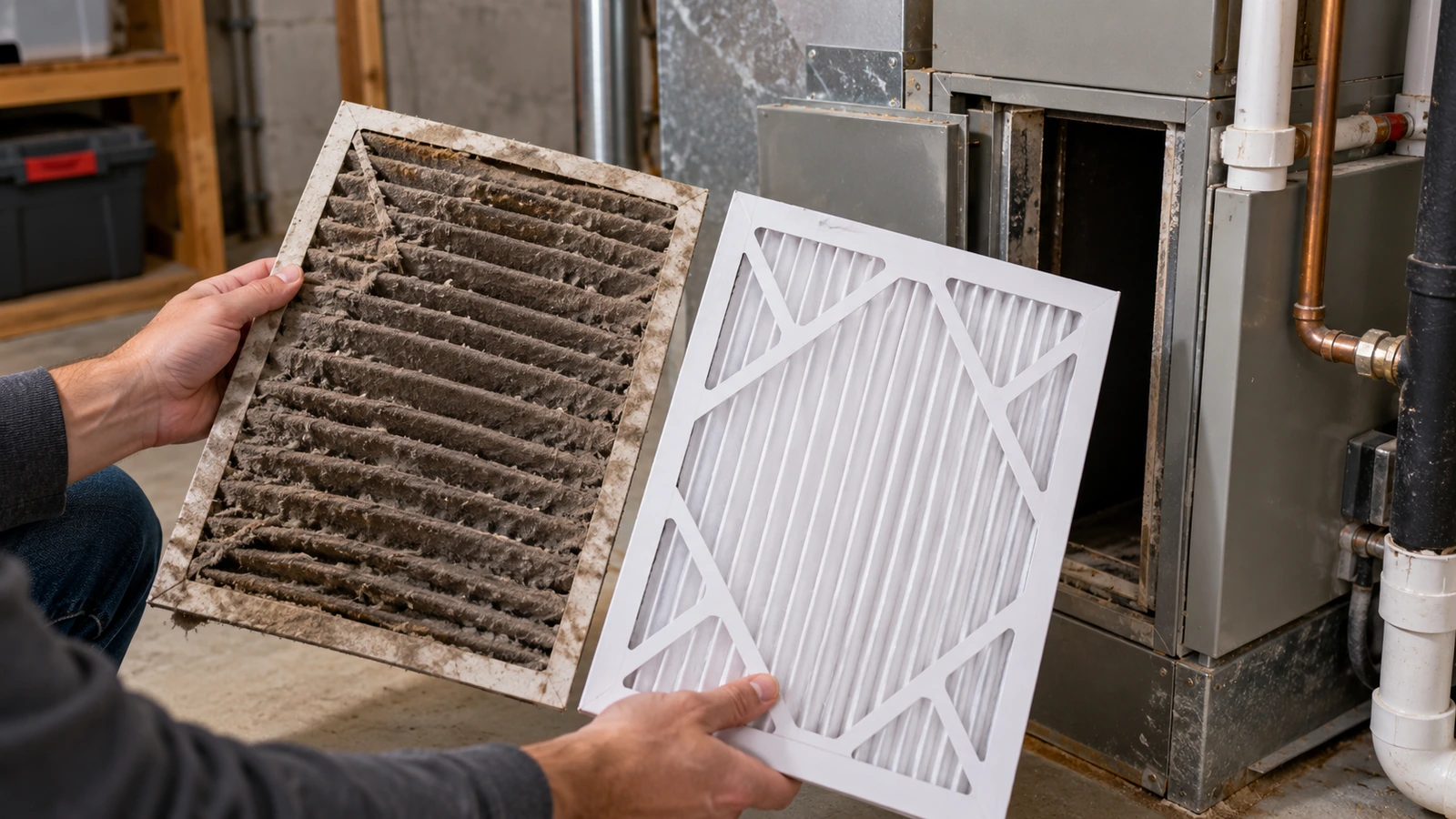
- Air filter. A clogged filter makes the furnace overheat and shut its burners off. Carrier recommends replacing 1-inch filters every 1 to 3 months; Lennox says to inspect them monthly.
- Furnace power switch and breaker. Trane: look for “an electric switch near the furnace (it can look like a light switch) and make sure it’s in the ON position.” Bryant: if a breaker “repeatedly trips, do not continue resetting it.”
- Gas valve. Trane: the shutoff is usually “within a few feet of your furnace”; check that it’s ON (handle in line with the pipe). If other gas appliances don’t work either, Carrier says to contact your utility.
- Blower door. Many furnaces have a door switch that cuts power when the panel isn’t seated. ICP’s homeowner manual asks: “Is the blower access door firmly in place?”
- Vents and returns. Carrier: “Open all heat vents” and make sure return grilles aren’t blocked “by furniture, rugs or other objects.”
Read the status light, without opening the furnace
Most modern furnaces have a control board with an LED that blinks a fault code. ICP’s manual says the code “can be seen through the view port in the blower access panel” and to record it before removing the door or turning off power. Trane says “you should not take the front panel off while your furnace is running.” Write the blink pattern down and match it to the chart on the inside of the door or in your manual, then give it to the technician. Carrier: “Do not attempt to repair or replace the control board yourself.”
Overheating: the limit switch shut the burners off
If the air turns cold partway through a cycle while the blower keeps running, the furnace has probably overheated. Carrier explains that the furnace “will shut down the burners and continue running the blower to cool the equipment.” Trane says the limit switch is “responsible for keeping your furnace from overheating” and that “a clogged air filter can adversely impact airflow and cause your furnace to overheat.”
- Replace the filter and open vents and returns, then let the furnace try again.
- If it keeps happening, the cause is a weak blower, blocked ducts or a cracked heat exchanger. Carrier warns a cracked heat exchanger “can leak carbon monoxide.”
⚠️ Caution: don’t reset or bypass safety switches
Trane: “Don’t attempt to bypass or reset the limit switch.” Some furnaces also have a manual-reset rollout switch, which trips when flames or hot gases escape the burner area, often a sign of a venting or heat-exchanger problem; one furnace service manual says “DO NOT jumper this switch.” Pressing it to get heat back can hide a carbon monoxide hazard. Leave it for a technician.
Ignition problems and the flame sensor
If the furnace clicks or glows but the burners don’t stay lit, the blower may still run and push out unheated air. Common causes are a dirty flame sensor, a worn hot-surface igniter, a pressure switch or inducer fault, or the gas valve. After repeated failed tries, many furnaces lock out; Trane says that after a hard lockout “you will need to call for furnace repair so that a technician can reset your furnace.”
⚠️ Caution: gas appliance. Technician-level checks
These parts sit in the burner compartment. Trane says “you should not attempt to clean or replace the flame sensor yourself,” and Lennox and Bryant also send flame-sensor service to a professional. What a technician checks:
- Flame sensor: a dirty sensor makes the furnace shut the burners off seconds after lighting. The technician cleans or replaces it.
- Hot-surface igniter: if it doesn’t glow, it is cracked or failed.
- Inducer motor and pressure switch: a blocked vent or failed inducer stops ignition for safety.
- Gas valve and control board: tested only after the cheaper causes are ruled out.
Older furnaces with a standing pilot: if the pilot is out, relight it only by following the lighting instructions on the label inside the furnace door. If it won’t stay lit, see furnace won’t ignite.
High-efficiency furnaces: blocked pipes and the condensate drain
High-efficiency (90%+) furnaces vent through two white PVC pipes and make water as they run. Both can stop the burners:
- Snow or ice on the outside pipes: Lennox’s manual says “after any heavy snow, ice or frozen fog event, the furnace vent pipes may become restricted” and to “remove any snow or ice” from the intake and exhaust pipes. Clear them gently from outside; don’t push anything into the pipes.
- Clogged condensate drain: Trane says a clog “triggers a safety measure that prevents the burners from igniting” and recommends a technician clear the drain line and pan. You can check that the drain hose to the floor drain or pump isn’t kinked or disconnected. See clogged condensate drain line.
Some rooms cold: ducts and vents
If the furnace makes heat but some rooms get cool air, look at the ductwork. A disconnected duct in an attic or crawl space can blow cold air into rooms. Carrier says visible leaks can be sealed “with metallic foil tape or mastic sealant”; disconnected or crushed ducts need a contractor.
What furnace repairs usually cost
| Repair | Typical cost | Source |
|---|---|---|
| Average furnace repair | $133 to $505 (about $318 average) | Angi, Sept 2026 |
| Flame sensor clean or replace | $80 to $250 | Angi; HomeGuide |
| Hot-surface igniter | $100 to $500 | HomeGuide; Angi |
| Limit switch | $100 to $400 | Angi; HomeGuide (Apr 2026) |
| Control board | $200 to $650 | Angi; HomeGuide |
| Thermostat installed | $114 to $264 | Angi, Sept 2026 |
Frequently asked questions
Why is my furnace blowing cold air when the heat is on?
Carrier says the most common cause is the thermostat fan set to ON instead of AUTO. Otherwise it is usually a clogged filter making the furnace overheat, an ignition problem, or a blocked condensate drain or vent pipe on a high-efficiency furnace.
Why does my furnace blow cold air before it blows hot air?
That is normal. The burners light first and the blower starts about 30 to 60 seconds later, so the first air can feel cool.
Should I turn my furnace off if it’s blowing cold air?
Carrier says it is usually not an immediate danger but does mean something is wrong. If you smell gas or see soot, turn it off and call a professional. Don’t keep restarting it.
How do I reset my furnace?
Turning the furnace switch off for a minute and back on resets some soft faults. If it has locked out after repeated failed ignitions, Trane says a technician needs to reset it after finding the cause. Never press or bypass a limit or rollout switch.
Why is my furnace blowing cold air and won’t shut off?
Either the thermostat fan is set to ON, or the furnace overheated and the blower is running to cool it down. Set the fan to AUTO and change the filter; if it continues, call a technician.
Can a dirty filter make a furnace blow cold air?
Yes. A clogged filter restricts airflow, the furnace overheats, and the limit switch shuts the burners off while the blower keeps running.
Related help: furnace short cycling · furnace won’t ignite · furnace not heating · furnace carbon monoxide
Sources: Carrier: furnace blowing cold air · Trane: furnace not blowing hot air · Trane: furnace limit switch · Trane: furnace not igniting · Trane: furnace hard lockout · Trane: furnace light blinking · Bryant: furnace blowing cold air · Lennox: furnace blowing cold air · Lennox EL296 user’s manual · ICP furnace homeowner’s information · Angi: furnace repair cost · HomeGuide: limit switch cost · HomeGuide: furnace repair cost · Angi: thermostat cost.
Updated October 22, 2026. Written and edited by Jordan Hale. General educational guidance; follow your furnace manual and use a licensed HVAC technician for gas and electrical work.