AC Running but Not Cooling? Causes and Fixes
Quick answer: When your AC is running but not cooling, start with the three things Carrier and Trane list first: the thermostat (set to COOL, fan on AUTO, and a setpoint below the room temperature), a dirty air filter, and a blocked or dirty outdoor unit. If the indoor coil or refrigerant lines are iced over, switch the system from COOL to OFF and let it thaw. If those checks don’t fix it, the cause is usually something a technician has to handle: low refrigerant from a leak, a failed capacitor or contactor, or a compressor problem.
Should you turn it off? Yes. Carrier says “you should turn off your AC if it is not cooling,” and to shut it off and call for service right away if you hear buzzing, smell burning or see ice on the coils. Running a system with a frozen coil or a failing compressor can turn a small repair into a big one.
AC running but not cooling? Match what you see
| What you notice | Most likely cause | Who fixes it |
|---|---|---|
| Air from the vents is room temperature; thermostat says heat or fan | Wrong mode or fan set to ON | You: thermostat settings |
| Weak airflow, dusty filter, some rooms worse than others | Dirty filter, closed or blocked vents | You: filter and vents |
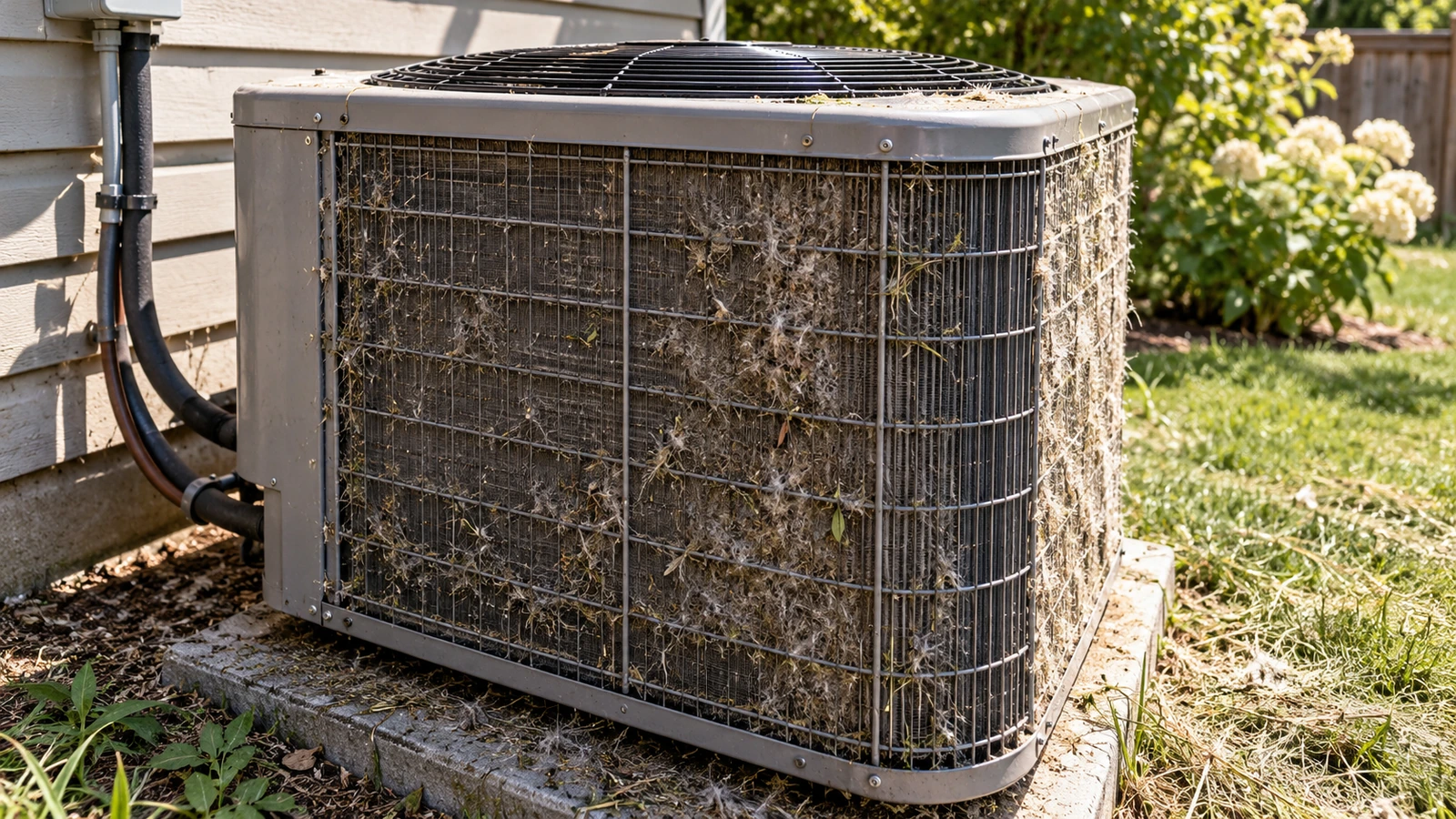
| Outdoor unit covered in leaves, grass or dirt | Outdoor coil can’t release heat | You: clear and rinse |
| Ice on the copper lines or indoor coil; water around the indoor unit | Frozen evaporator coil | You: turn off and thaw; pro if it refreezes |
| System suddenly shut off on a hot, humid day; water in the drain pan | Condensate float (safety) switch tripped | Pro: float switch |
| Indoor fan runs; outdoor unit hums but its fan doesn’t spin | Failed capacitor | Pro: capacitor |
| Indoor fan runs; outdoor unit is completely silent | Outdoor disconnect off, breaker, contactor or a safety lockout | You check the switch; pro for the rest |
| Hissing sound, ice, warm air and rising energy bills | Refrigerant leak | Pro: refrigerant |
| Cools a little, runs all day, house never reaches the setpoint | Extreme heat, undersized system, leaky ducts or low refrigerant | Pro diagnosis |
1. Check the thermostat settings
Trane’s checklist starts here: “Make sure your thermostat is set to cool and didn’t get bumped to heat,” make sure “the fan is set to AUTO,” and that the setpoint is lower than the current indoor temperature. With the fan on ON, the blower keeps running between cooling cycles and blows room-temperature air, which feels like the AC isn’t cooling.
- Set the mode to COOL and the temperature a few degrees below the room. Trane suggests “2 to 4 degrees below room temperature” to test.
- If the display is blank, Trane says it “may need new batteries.”
- After a change, wait a few minutes: many thermostats delay the compressor to protect it. Honeywell says this delay “can be up to five minutes under normal operating conditions.”
- Thermostat dead or not calling for cooling at all? See thermostat not turning on the AC.
2. Dirty filter, closed vents and weak airflow
A clogged filter is the most common reason a working AC cools poorly, and it is also the main cause of frozen coils. ENERGY STAR advises inspecting, cleaning or changing filters once a month; the U.S. Department of Energy says to clean or replace filters “every month or two during the cooling season,” more often with pets or dust.
- Replace a grey, dusty filter with one of the same size.
- Open supply vents and keep return grilles clear of furniture and rugs.
- One room warm and the rest fine usually points to ducts or airflow balance rather than the AC itself.
3. Dirty or blocked outdoor unit
The outdoor unit (condenser) has to release the heat taken out of your house. The DOE recommends trimming plants back at least 2 feet, and Trane suggests keeping plants at least two feet away and gently hosing down the outdoor coil.
- Switch the system off at the thermostat and turn off the outdoor disconnect switch (the box on the wall next to the unit). Carrier says to “ensure power is off before attempting to clean debris.”
- Pull leaves, grass clippings and debris away from the sides of the unit.
- Rinse the outside of the coil fins gently with a garden hose from the outside. Don’t use a pressure washer, and don’t remove the fan grille or any panels.
- Turn power back on and run the system.
4. Frozen evaporator coil
Ice on the copper refrigerant lines or the indoor coil stops the system cooling. Trane says the biggest reason a coil freezes “is restricted airflow,” so check the filter and vents too.
- Trane: “Go to your thermostat and switch it from COOL to OFF.” Carrier says to turn it off immediately “to allow the ice to thaw and avoid damaging the compressor.”
- Let it thaw. Carrier says this typically takes 1 to 4 hours, longer for heavy ice. Trane warns: “DO NOT chip away at the ice,” and Carrier says not to use hairdryers or heaters to speed it up.
- Put towels or a bucket out: American Standard says to expect 1 to 2 gallons of water as the ice melts.
- Replace the filter, then restart in COOL. If the coil freezes again, call a technician: repeated freezing with good airflow points to low refrigerant or a blower problem.
5. Condensate float switch tripped
Many systems have a float (overflow) switch in the drain pan or drain line. If the condensate drain clogs and water backs up, Trane says the switch “will shut the outdoor compressor and condenser fan down” and can also shut down the indoor fan, so the system suddenly stops cooling on a hot, humid day. Water in the drain pan is the clue. Trane says fixing the clog “is best left to a trained HVAC technician.” Don’t bypass the switch: it is there to stop water damage. For water on the floor, see AC leaking water inside the house.
6. Low refrigerant (a leak)
An AC doesn’t use up refrigerant; if it is low, there is a leak. Bryant lists the signs as “warm air blowing from your vents,” “a sudden spike in your monthly energy bills,” “ice building up on the indoor evaporator coil” and “a faint hissing sound.” Carrier says: “If you suspect a leak, do not attempt to fix it yourself.” Finding and repairing leaks and adding refrigerant require EPA Section 608 certification; adding refrigerant without fixing the leak is a temporary fix.
7. Failed capacitor, contactor or compressor
The capacitor gives the compressor and outdoor fan motors the boost they need to start; the contactor is the switch that turns them on. When either fails, the indoor fan may run while the outdoor unit doesn’t, so you get air that isn’t cold. Bryant describes the signs a homeowner can notice: “The outdoor unit hums but the fan isn’t spinning,” or “the fan runs, but the compressor… fails to engage.”
⚠️ Caution: high voltage. Leave this to a technician
Capacitors stay dangerous after the power is off. Carrier warns they “can cause serious injury or death, even when the power is disconnected” and “strongly recommends that homeowners do not attempt AC capacitor replacement themselves.” Trane and Bryant say the same. What you can safely do:
- Turn the system off at the thermostat so a struggling compressor isn’t left running.
- Note what you hear and see from outside the unit (humming, fan not spinning, clicking, burning smell) to tell the technician.
- Don’t open the outdoor unit’s electrical panel, push the fan to start it, or test parts with a meter.
A technician will test the capacitor’s rating with a meter, check the contactor and the compressor, and replace the failed part with one of the correct rating.
8. Other reasons the house won’t cool down
- Outdoor disconnect or service switch off: Carrier says to verify the outdoor switch “has not been turned off or pulled out,” and that any indoor switch is on.
- Breaker: reset a tripped AC breaker once. If it trips again, leave it off and call a technician; Lennox notes repeated trips indicate a bigger electrical issue, and Trane advises not to keep flipping it.
- Extreme heat: on the hottest days, a correctly sized system may run all afternoon and still sit a few degrees above the setpoint.
- Leaky ducts or an undersized system: rooms far from the unit stay warm; a contractor can test the ducts and check the sizing.
- Heat pump not in cooling mode: a heat pump stuck in heat mode blows warm air; a technician checks the reversing valve.
How to reset an AC that isn’t cooling
- Set the thermostat to OFF.
- Turn off the AC breaker(s) at the panel. Carrier says to “wait at least 5 minutes before switching the breaker back on.”
- Turn the breaker back on, set the thermostat to COOL below room temperature, and wait for the compressor delay.
- If the breaker trips again, or the system still doesn’t cool, stop and call a technician.
What AC repairs usually cost
| Repair | Typical cost | Source |
|---|---|---|
| Average AC repair | $172 to $664 (about $417 average) | HomeAdvisor, June 2026 |
| Service call | $75 to $200 | HomeAdvisor, June 2026 |
| Capacitor replacement | $200 to $400 | Angi, Aug 2026 |
| Contactor replacement | $20 to $320 (about $220 average) | Angi, July 2026 |
| Refrigerant leak repair | $250 to $1,600; leak detection $100 to $450 | Angi, July 2026 |
| Compressor replacement | $1,200 to $2,800 | HomeAdvisor, June 2026 |
Frequently asked questions
Why is my AC unit running but not cooling?
Usually wrong thermostat settings, a dirty filter or a dirty or blocked outdoor unit. If those check out, a frozen coil, low refrigerant, a tripped float switch or a failed capacitor or contactor are the next suspects, and those need a technician.
Should I turn off my AC if it’s not cooling?
Yes. Carrier says to turn it off, especially if you hear buzzing, smell burning or see ice. If the coil is frozen, switch from COOL to OFF and let it thaw.
How do I reset my central AC?
Turn the thermostat off, switch off the AC breaker, wait at least 5 minutes, turn it back on and set the thermostat to COOL. If the breaker trips again, leave it off and call a technician.
How can I tell if my AC is low on refrigerant?
Warm air from the vents, ice on the indoor coil or copper lines, a hissing sound and rising energy bills are the common signs. Only a certified technician can confirm a leak and recharge the system.
How long does it take a frozen AC coil to thaw?
Carrier says typically 1 to 4 hours with the system off, and longer for heavy ice. Don’t chip at the ice or use a heater on it.
Why is my AC blowing air but not cold air with the outdoor unit humming?
An outdoor unit that hums but whose fan doesn’t spin is a classic sign of a failed capacitor. Turn the system off and call a technician; capacitors are dangerous to handle even with the power off.
Can I replace an AC capacitor myself?
Manufacturers say no. Carrier, Trane and Bryant all advise leaving capacitor replacement to a qualified HVAC technician because of the stored high-voltage charge.
Related help: thermostat not turning on the AC · AC leaking water inside the house · mini split not cooling · heat pump not heating · RV air conditioner (Dometic) not cooling
Sources: Carrier: AC not blowing cold air · Carrier: AC capacitor · Carrier: frozen AC coil · Trane: AC not blowing cold air · Trane: frozen evaporator coil · Trane: overflow switch · Bryant: refrigerant leaks · Bryant: capacitor replacement · American Standard: frozen coil · Lennox: AC not blowing cold air · Honeywell: thermostat wait delay · ENERGY STAR: maintenance checklist · U.S. DOE: maintaining your air conditioner · EPA: Section 608 certification · HomeAdvisor: AC repair cost · Angi: capacitor cost · Angi: contactor cost · Angi: refrigerant leak repair cost.
Updated October 22, 2026. Written and edited by Jordan Hale. General educational guidance; follow your equipment manual and use a licensed HVAC technician for electrical and refrigerant work.