EPA 608 Certification vs. an HVAC License: What Is the Difference?
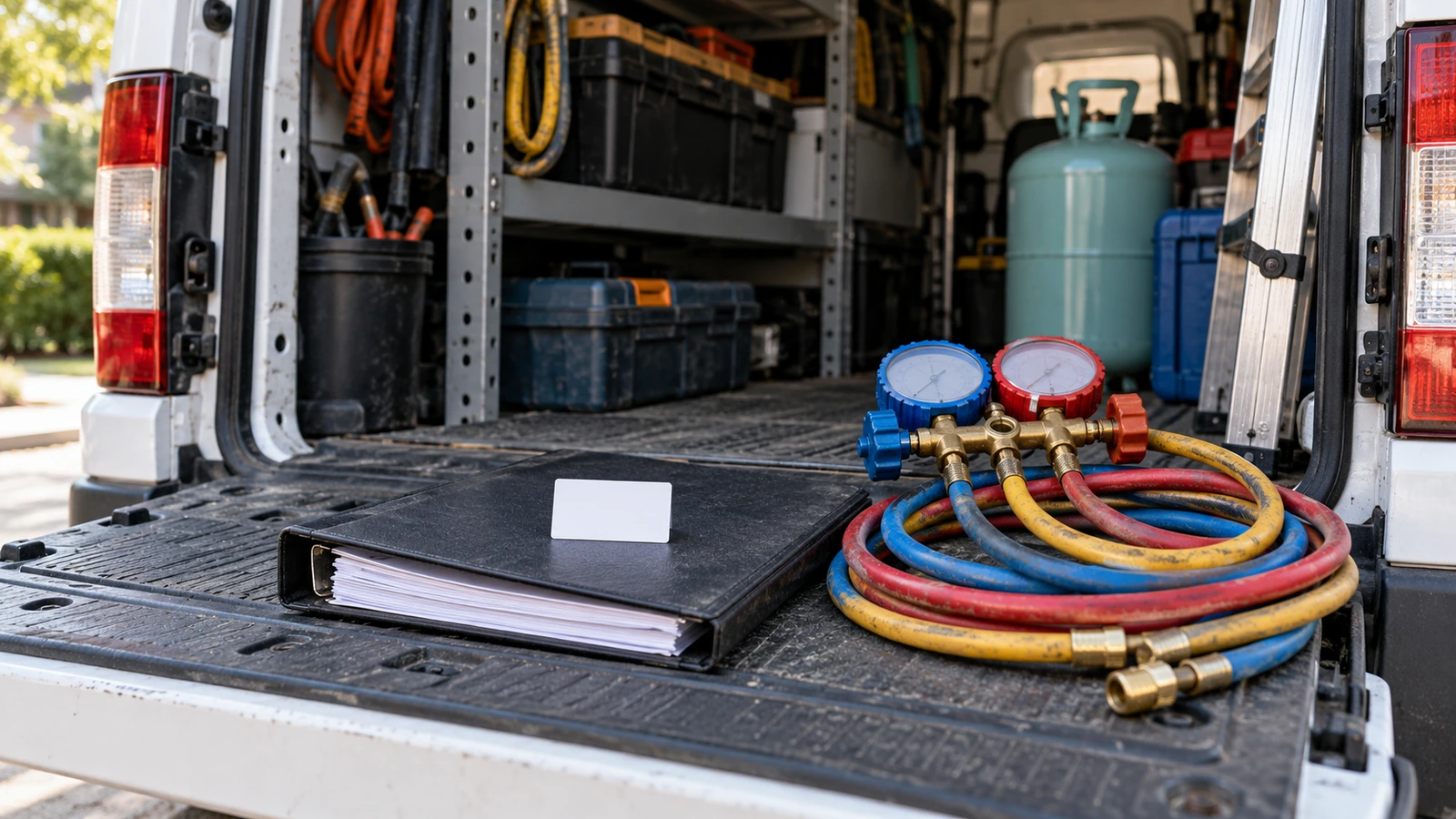
Quick answer: No, they are not the same thing. EPA Section 608 certification is a federal refrigerant-handling credential for technicians who service stationary air-conditioning and refrigeration equipment, and it is valid in every state. An HVAC license is issued by a state or city and controls who may contract for work, pull permits, supervise others or run an HVAC business. Many technicians need both.
In this guide
They solve different problems
| EPA Section 608 certification | HVAC license | |
|---|---|---|
| What it covers | Handling refrigerant in stationary A/C and refrigeration equipment | Contracting, installation, permits, business operation and safety codes |
| Who issues it | An EPA-approved certifying program | A state licensing board, and sometimes a city or county |
| Where it’s valid | Nationwide | Only in the issuing state or city |
| How you get it | Pass a multiple-choice exam (Core plus one or more types) | Usually documented experience, an exam, insurance or bonding, and fees |
| Does it expire? | No | Yes, on the board’s renewal schedule |
A technician can hold a Section 608 credential and still be unable to lawfully run an HVAC contracting business where a contractor license is required. The reverse is also a problem: a licensed contractor still needs Section 608 certification, or certified employees, before doing refrigerant work that could open the refrigerant circuit.
HVAC credentials decoded
“HVAC certification” can mean several different things. Here’s what each one is:
| Credential | Required by law? | What it shows |
|---|---|---|
| EPA Section 608 | Yes, federally, for refrigerant work on stationary equipment | You know the refrigerant handling and recovery rules |
| EPA Section 609 | Yes, federally, for paid motor vehicle A/C work | Vehicle A/C refrigerant handling |
| State or local license or registration | Yes, where the state or city requires it | You may legally do or contract the work there |
| NATE certification | No, it’s voluntary | Tested skill in specific equipment areas; renewed every two years |
| Trade school certificate | No | You completed a training program |
Employers often ask for NATE or a school certificate as proof of skill, but neither replaces EPA certification or a required license. See is NATE certification worth it?
When Section 608 matters
EPA requires Section 608 certification for technicians who maintain, service, repair or dispose of appliances when the work could reasonably be expected to release refrigerant, such as attaching gauges, adding or recovering refrigerant, or opening the circuit. Apprentices are exempt only while they are closely and continually supervised by a certified technician. The certification type should match the equipment: most home split systems and heat pumps need Type II, and Universal covers Types I, II and III.
Section 608 also controls buying refrigerant: suppliers may only sell it to certified technicians or their employers. See can you buy refrigerant with EPA 608 certification?
When local licensing matters
Local requirements vary. A jurisdiction may distinguish between working as an employee under supervision and advertising, bidding, pulling permits, signing contracts or operating a company. Many states use tiers such as apprentice, journeyman, master and contractor, and some separate residential, commercial, electrical, gas or refrigeration work. Check the contractor licensing board and building department where the work happens, not just where your employer is based.
Two state examples
These show how differently states handle it. Always check the current rules with the board.
- Texas: anyone who assists a licensed air conditioning and refrigeration contractor with maintenance or repair must register with the Texas Department of Licensing and Regulation. Registered technicians must work under a licensed contractor’s supervision, can’t advertise A/C services themselves, and renew every year (the application fee is $20). Running the business takes a separate contractor license.
- California: HVAC contracting falls under the Contractors State License Board’s C-20 (warm-air heating, ventilating and air-conditioning) classification. Since January 1, 2025, unlicensed work is allowed only on jobs under $1,000 that need no permit and no employees, so most HVAC installations require a licensed contractor.
Which should you get first?
- Starting out: get EPA 608 first. It’s a single exam, costs roughly $85 to $175 online, never expires and is needed for almost any refrigerant work. Many employers expect it before your first day. See how to get EPA 608 certification.
- Working for a company: check whether your state requires a technician registration or apprentice license, and get it before you start.
- Going out on your own: you’ll need the state or local contractor license, plus insurance and permits, on top of your EPA certification.
A practical way to plan your path
- List the equipment and jobs you expect to do.
- Pick the Section 608 type that matches that equipment (Universal if unsure).
- Check your state licensing board and local building department for trade and business requirements.
- Ask your employer whether it requires additional manufacturer, safety or apprenticeship credentials.
- Keep the requirements separate in your records so renewal dates and proof don’t get mixed up.
Licensing rules change and can depend on the dollar value, scope and location of a job. This guide explains the distinction, not the license rule for every city or state, so verify the local requirement before accepting work.
EPA certification vs license questions
Is EPA certification the same as HVAC certification?
EPA certification is one kind of HVAC credential, and the only one required by federal law for refrigerant work. “HVAC certification” can also mean NATE, a school certificate or a state license, which are separate.
Is an EPA 608 card a license?
No. People often call it an “EPA license” or “refrigerant license,” but it’s a federal certification. It lets you handle refrigerant; it doesn’t let you contract HVAC work where a state license is required.
Is EPA 608 certification valid in all 50 states?
Yes. It’s a federal credential, so it’s valid everywhere in the U.S., unlike a state license.
Do I need EPA 608 if I’m already licensed?
Yes, if you personally do refrigerant work. A state license doesn’t replace the federal refrigerant certification.
Does the 608 vs 609 difference matter here?
Yes. Section 609 is for motor vehicle A/C only. Home and commercial systems need Section 608. See EPA 608 vs 609.
Sources
- U.S. EPA: Section 608 technician certification requirements
- U.S. EPA: Section 608 certification programs
- TDLR: Texas A/C and refrigeration technician registration
- CSLB: minor work exemption increases to $1,000 (AB 2622)
- NATE: recertification policies
Updated October 28, 2026.